
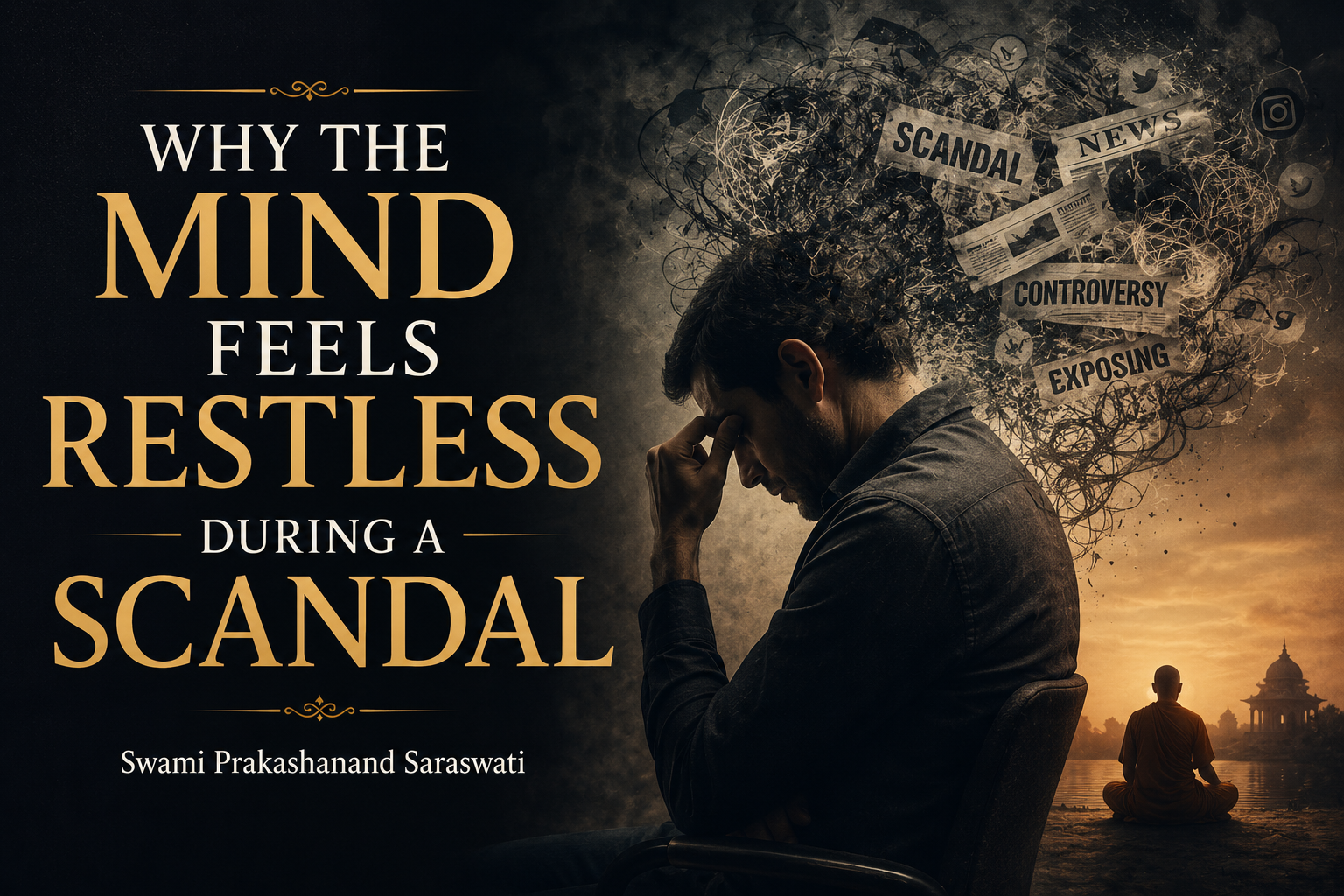
A scandal affects more than public image. It affects mental stability. Even people who appear calm externally may experience continuous inner disturbance. Thoughts become repetitive, sleep gets affected, and attention starts shifting from daily responsibilities toward the situation. Swami Prakashanand Saraswati explains that the mind becomes restless because it loses its balance between external events and inner understanding.
One reason for this restlessness is uncertainty. The mind wants clarity and control. During a scandal, both become difficult to achieve. Questions remain unanswered, reactions from people keep changing, and the future can become a source of worry. The mind keeps searching for resolution, but this constant thinking does not produce peace.
Swamiji teaches that the mind naturally moves toward whatever receives the most emotional attention. When a public situation becomes emotionally charged, the mind begins revolving around it continuously. Even in silence, internal conversations continue. This repeated mental activity creates exhaustion.
Another cause of restlessness is attachment to reputation. When identity becomes connected with how others see us, public criticism feels personal and threatening. The mind then starts defending an image instead of staying grounded in reality. Swamiji explains that external opinion changes quickly, but the mind treats it as permanent. This misunderstanding increases anxiety.
There is also the pressure of anticipation. The mind starts imagining future reactions, future conversations, and future consequences. Many of these situations never actually happen, but the mind still spends energy preparing for them. This habit creates unnecessary disturbance.
Swami Prakashanand Saraswati points toward awareness as an important shift. Restlessness grows when thoughts move automatically without observation. The moment a person begins noticing the movement of the mind, the intensity starts reducing. Observation creates distance between the individual and the thought process.
He also explains that the mind becomes restless when daily balance breaks. A scandal often changes routines. Normal focus disappears. Spiritual practices, work habits, and peaceful activities get replaced by overthinking. Restoring simple structure in daily life helps stabilize the mind again.
Another important factor is emotional dependence on outcomes. The mind keeps waiting for complete correction, complete acceptance, or complete understanding from others. When these expectations are delayed, frustration increases. Swamiji teaches that peace cannot depend entirely on external resolution.
Faith also plays a role in reducing restlessness. When the mind believes it must solve everything alone, pressure increases. Trust in divine guidance creates mental relief. This trust does not remove responsibility, but it reduces panic.
Swamiji explains that a restless mind reacts quickly and thinks poorly. A steady mind observes first. This difference changes how situations are experienced. The scandal may remain outside, but the level of disturbance inside begins to decrease.
Restlessness does not begin in the situation itself; it begins in how the mind handlesthe situation.
Radhey Radhey